Lisa Simeon: Veterans, Your Mission Continues
Video



Agile software development took shape in 2001, when 17 software practitioners wrote the Manifesto for Agile Software Development as an alternative to heavyweight, plan-driven methods. Over the next two decades, it became a standard approach for federal software development.
Agile replaced long, rigid project plans with short cycles that let teams adapt as they learned—and it has served government agencies well. But agile was designed around the realities of human teams: small cross-functional teams, fixed sprint capacity, scheduled ceremonies, story-point estimation, and shared context carried in conversation rather than documents.
Those practices made sense when every line of code depended on a person's time and attention. I know those constraints firsthand from 14 years running agile at USDA, where I led five concurrent release trains with more than 550 team members.
Agentic platforms change several of the assumptions agile was built on. Capacity is no longer fixed by headcount. Coordination no longer waits for the next scheduled meeting. Story points, which estimate human effort, say little about the real risk in a piece of work. And agents can work in parallel rather than passing work down a line.
Agents still need clear, explicit direction. They cannot fill gaps with a hallway conversation or years of institutional memory. A vague requirement that a human team would quietly resolve can lead an agent to build the wrong thing quickly.
As execution speeds up, the quality of the direction behind it carries more weight.
Google Cloud's State of AI-assisted Software Development report lays this out. Among nearly 5,000 technology professionals, it found that AI (sometimes known as SI) acts primarily as an amplifier, making strong delivery organizations stronger and exposing the weaknesses of struggling ones. The greatest returns came from clear workflows, strong internal platforms, and aligned teams. Teams with loosely coupled architectures and fast feedback loops saw gains, while those with rigid systems and slow processes saw little or no benefit. Many agencies running legacy systems will recognize themselves in that second group.
A post-agile delivery model keeps the essential adaptability and adds deliberate elaboration before execution, so agents begin with a clear understanding of what to build and why.
Deep planning before execution sounds like waterfall. It isn't. Waterfall failed because being wrong was expensive: months of planning thrown over a wall, and a change in requirements meant starting over. When agents do the building, a change costs hours, not months, and any phase can loop back to an earlier one.
People must remain at the center of delivery: defining intent, making judgment calls, evaluating outputs, and staying accountable for results. Routine execution moves to agents. Ambiguous or high-impact decisions should pause for human judgment.
People also decide what agents are allowed to do. They set each agent’s permissions, define when work must stop for review, and use the record of agent actions to stay accountable for the results. Federal standards are moving in the same direction. In February 2026, NIST launched its AI Agent Standards Initiative, which counts agent identity and authorization among its research priorities as the basis for secure interactions between people and agents.
Abt built a methodology for SI-enabled software development around this human-led, agent-first model. Called Driftless Logic, this methodology puts into place deep elaboration before execution, specialized agents working under human guidance, continuous verification, and an auditable record of every decision and action.
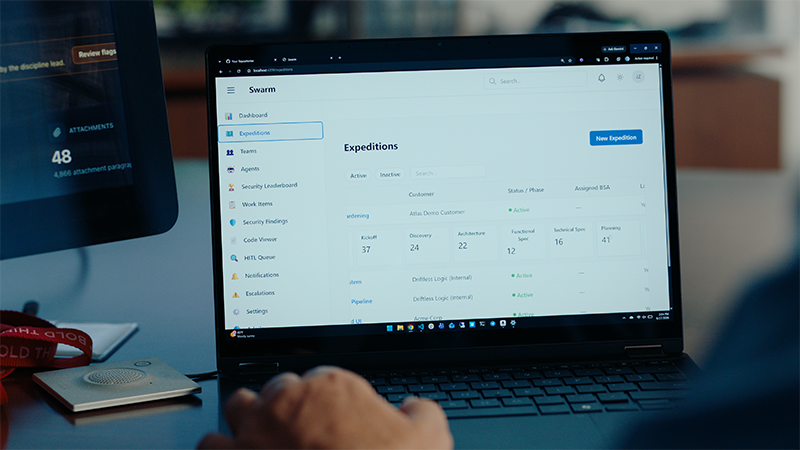
Two solutions put the methodology into practice: Driftless Discovery maps what an existing system actually does before modernization begins, and Driftless Swarm coordinates specialized agents that plan, build, test, and review software under human guidance.

The name comes from the Driftless Area of the upper Midwest, rugged terrain the last glaciers bypassed, leaving none of the "drift" of sand and debris they deposited everywhere else. The region’s ridges, coulees, and spring-fed valleys kept their original shape.
The Driftless methodology takes the same approach to software. Every project has its own terrain, full of features that exist for reasons teams need to understand before deciding how to move through them. Driftless maps that terrain, presents options and their tradeoffs, and lets agents navigate with a human compass at vital junctures. It avoids the drift of technical debt and inherited process, and it relies on preparation, expertise, and judgment to move quickly through complex ground.
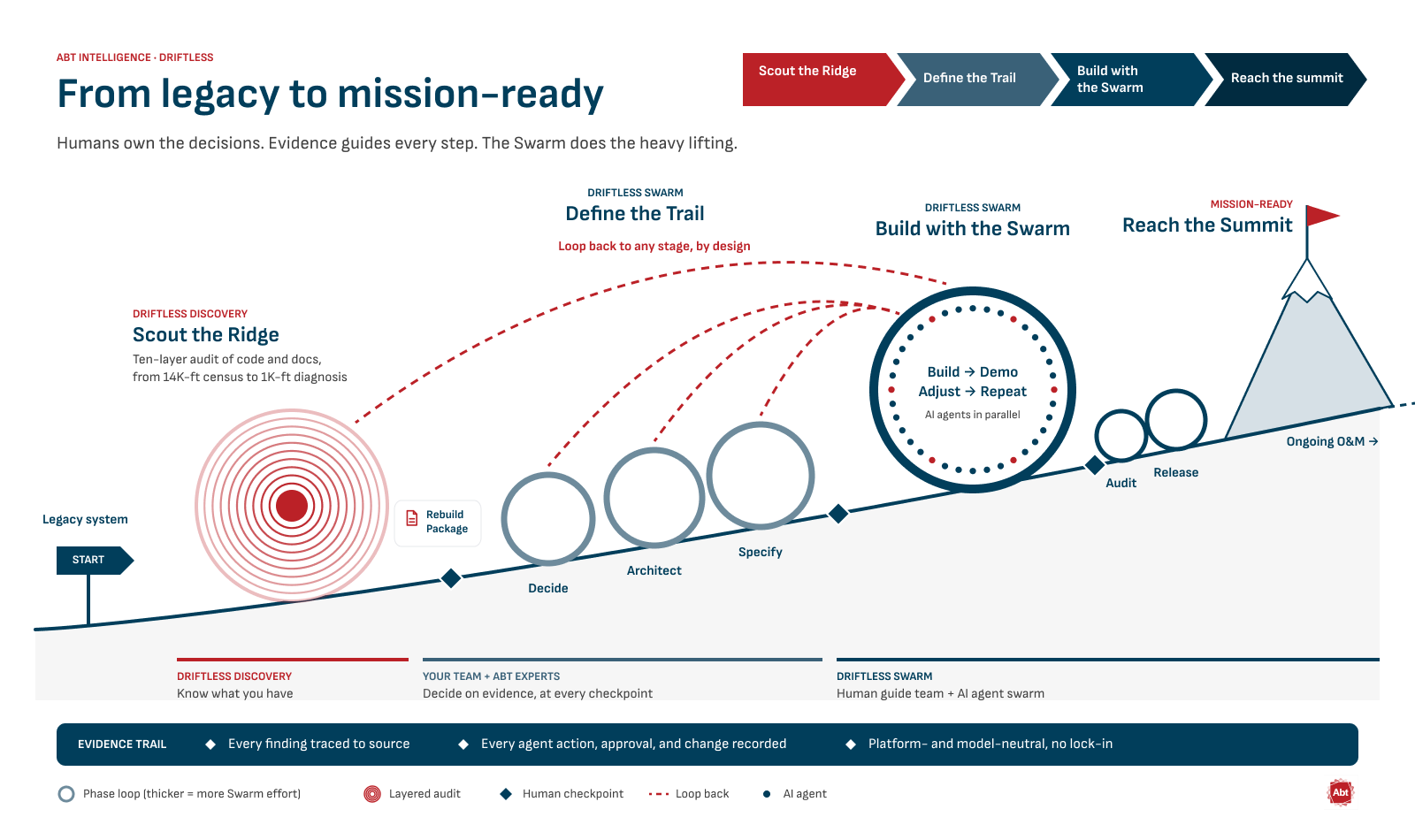
Driftless has four stages. Each works as a loop, so any stage can return to an earlier one when new evidence calls for it. People set the intent and guide the work continuously, as agents carry it out.
1. Scout the Ridge: Know what you are working with.
Every engagement begins with a go/no-go decision, followed by kickoff and business discovery led by a small Scouting Team. Before anyone commits to a rebuild path, Driftless Discovery examines the existing application's code, documentation, and user materials to map its capabilities, dependencies, unused code, risks, and the open decisions stakeholders need to make. The stage ends at a human checkpoint.
2. Define the Trail: Plan before you build.
Driftless Swarm, Abt’s agentic software modernization platform, uses a 3-5 person Guide Team to direct solution architecture, functional and technical specifications, and development planning. Instead of story points, work is sized by its complexity, novelty, and exposure. Routine, low-risk work goes to agents with more autonomy, while novel or high-stakes work gets closer human involvement. This stage also ends at a human checkpoint.
3. Build with the Swarm: Execute in continuous loops.
Specialized agents plan, build, test, and review in parallel, in a continuous cycle of build, demo, adjust, and repeat. Work passes between agents and people based on trust: each agent's level of autonomy grows with clean, reliable delivery and tightens quickly when problems surface (and honestly reported failure is rewarded, while a hidden one is penalized). Audits confirm that the delivered work matches what was specified.
4. Reach the Summit: Deliver and sustain.
The finished system moves into operations and maintenance as a continuous flow. Because the methodology keeps a full record of decisions and changes, the people sustaining the system know why it was built the way it was, which helps keep new technical debt from building up.
What runs through every stage.
The agentic era will reward government agencies that redesign delivery around their new workforce. Those agencies will modernize based on evidence, deliver faster while keeping quality and control, and stop paying interest on legacy systems.
Know the terrain. Choose your route. Move with confidence.
Talk to our team to map your modernization path with Driftless.

Abt Global, Lead Platinum Sponsor of the POC 2026 Healthcare Summit, joins federal health leaders on AI, data, and access and hosts an AI governance panel.

Abt is a Gold Sponsor of APPAM 2026. Catch us in Boston, in our sessions and at booth 304, or connect with the team here!

Abt Global is a Sapphire sponsor of the NAMD 2026 Fall Conference. Find our Medicaid policy and data team at Booth 122.

Stronghold Federal’s GSA MAS award gives agencies streamlined access to IT modernization, data, and systems integration services.

How explainable, human-guided AI can help Medicaid programs focus on meaningful fraud signals, reduce noise, and act earlier.

Abt wins a seat on a USACE IDIQ supporting the data and analytics behind lock monitoring, dredging, and U.S. waterway statistics.

We combine topical expertise, environmental science, data analytics, & engineering to help agencies modernize systems & use data to support better decisions.

Readiness is a data problem. We have solutions. Book a demo of our defense health data tools and meet our military health team.