



Nearly $1 trillion flowed through Medicaid in fiscal year 2024, supporting health coverage for tens of millions of Americans. At that scale, even a small percentage of incorrect payments can represent billions of dollars. Indeed, for fiscal year 2025, CMS estimated $37.39 billion in Medicaid improper payments—a 6.12 percent improper payment rate.

However, an improper payment is not necessarily fraud. It can also reflect issues such as insufficient documentation, eligibility errors, or payments made in the wrong amount.
For state Medicaid leaders, the challenge is turning program data into actionable information to identify and address improper payments. For example: Where are improper payments most likely occurring? Which provider, plan, beneficiary, or service patterns warrant closer review? What is the cause of the improper payments and what action should the state take next?
Medicaid program integrity teams need an analytics system that goes beyond finding anomalies. They need one that helps them distinguish legitimate variation from meaningful risk—and decide what to do next.
What should modern Medicaid program integrity look for?
Potential fraud often shows up as something that doesn’t fit the expected pattern: unusually high billing, unexpected utilization, or a provider behaving differently from its peers.
But an outlier is a clue, not a conclusion. For example, a rural provider may be flagged because its patients come from a much wider geographic area than those of its peers, even though the explanation is simply that there are few alternatives nearby. On the other hand, potentially fraudulent activity may be spread across providers, services, beneficiaries, geographies, or time so that no single transaction looks especially unusual.
This tension shaped Abt’s approach in CMS’s Crushing Fraud Chili Cook-Off Competition, where our Fraud, Waste, and Abuse (FWA) solution was selected among the top 10 out of 200+ submissions. Rather than stopping at an anomaly or risk score, our approach looks for patterns tied to real fraud mechanisms, tests whether there is a legitimate explanation, and gives investigators the evidence behind the signal, not just the flag.
Which Medicaid fraud signals deserve attention?
For a program integrity team, every alert creates work. Someone has to review it, understand what may be driving it, and decide whether further action is justified. False positives consume limited investigative capacity.
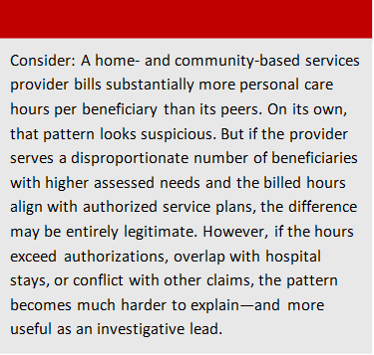
In our solution, validation separates statistical outliers from signals that warrant a closer look. The strongest signals are the ones that remain difficult to explain after accounting for legitimate operating differences, particularly when multiple behaviors or relationships point to the same underlying pattern.
For states evaluating new analytics or AI tools, this offers a useful measure of value. Instead of asking, “How many risks can the system flag?” they should be looking at whether it helps their staff understand which signals deserve attention first, and why.
Let’s talk explainability.
Explainability means being able to understand and clearly articulate why a model or analytical process flagged something as risky. This principle is central to Abt’s FWA solution. Rather than producing a black-box risk score, our approach generates what we call a “white box” view of the signal: a rationale for why a provider was flagged, including the features, behaviors, or relationships that made the provider stand out. The goal is not to make an automated determination of fraud, but to give investigators a clearer starting point for review and help them understand what may warrant a closer look.
For example, rather than simply showing an investigator that a claim ranked as high risk, the analysis surfaces the specific inconsistency behind that designation—such as a lack of expected patient-physician relationship—and helps the investigator understand how the individual signals fit together into a case theory.
Moving program integrity upstream toward prevention.
While explainability can help investigators act on risk, upstream controls create opportunities to catch and address potential issues earlier. For Medicaid agencies managing complex programs with finite staff and resources, prevention and earlier intervention can matter just as much as better detection.
To surface inconsistencies, our approach connects the data used to make eligibility, payment, and other program decisions and embeds automated rules and validation checks into those workflows.
Investigators and retrospective audits still play an important role, but earlier controls give states another opportunity to identify and address risk before more program dollars are spent.
Where does AI fit in Medicaid program integrity?
AI has an important role to play in program integrity, but it should not be the final arbiter of what constitutes fraud.
The signals still need human judgment. There is no substitute for people who understand how legitimate care is delivered, how Medicaid programs operate, and how fraud schemes evolve.
Use AI for what it does particularly well: reviewing large volumes of data, identifying patterns difficult to spot manually, and supporting a weighted prioritization of signals for closer review where analysts can bring in public provider data to determine whether investigation is warranted.
Through this approach, AI can help states focus their resources where they can be most impactful.
The opportunity ahead.
Abt brings together the expertise, technology, and implementation support to put these principles into practice. Our perspective is shaped by six decades of work with CMS and across Medicaid-related programs, spanning evaluation, payment, quality, managed care, data analysis tools and dashboards, and program operations.
Let’s talk about what stronger, more actionable program integrity could look like for your Medicaid program. Catch us at the 2026 NAMD Conference or connect below.