

Lisa Simeon: Veterans, Your Mission Continues
Video


Authored by: Abt's National Health Workforce Collaborative Team
Rural healthcare in America depends on a workforce that is well-trained, supported, and integrated with the community. Yet 92% of rural counties are designated primary care shortage areas—many with five or fewer physicians, and some with none at all.i Additionally, two-thirds of mental health shortage areas are in rural regions.ii, iii
Workforce shortages lead to delayed care, higher rates of chronic disease, lack of adequate maternal care, and preventable deaths.iv For states, addressing workforce gaps is not optional; it’s foundational to improving health outcomes and sustaining rural economies.
States now have a historic opportunity: The federal Rural Health Transformation Program (RHTP) will invest $50 billion over five years to strengthen rural systems. The question is how to invest in strategies that recruit and retain workforce, redesign care, and rebuild trust.
Health centers are the backbone of community-based healthcare, serving over 32 million patients in the U.S. and providing a vital source of primary care in medically underserved areas.v In rural communities, health centers are often the only access point for care—not just for medical needs but for behavioral health, dental, and social services. Unfortunately, workforce shortages affect health centers more significantly than other types of healthcare organizations because they have limited resources to offer competitive salaries.vi Other barriers include:
Through the Health Resources and Services Administration (HRSA) National Health Workforce Collaborative, Abt engaged more than 900 stakeholders across all 10 HRSA regions—including 300+ health centers—to surface barriers and promising practices.
Below are effective, actionable approaches—grounded in Abt’s engagement findings and national evidence—that states and health centers can adopt and adapt.
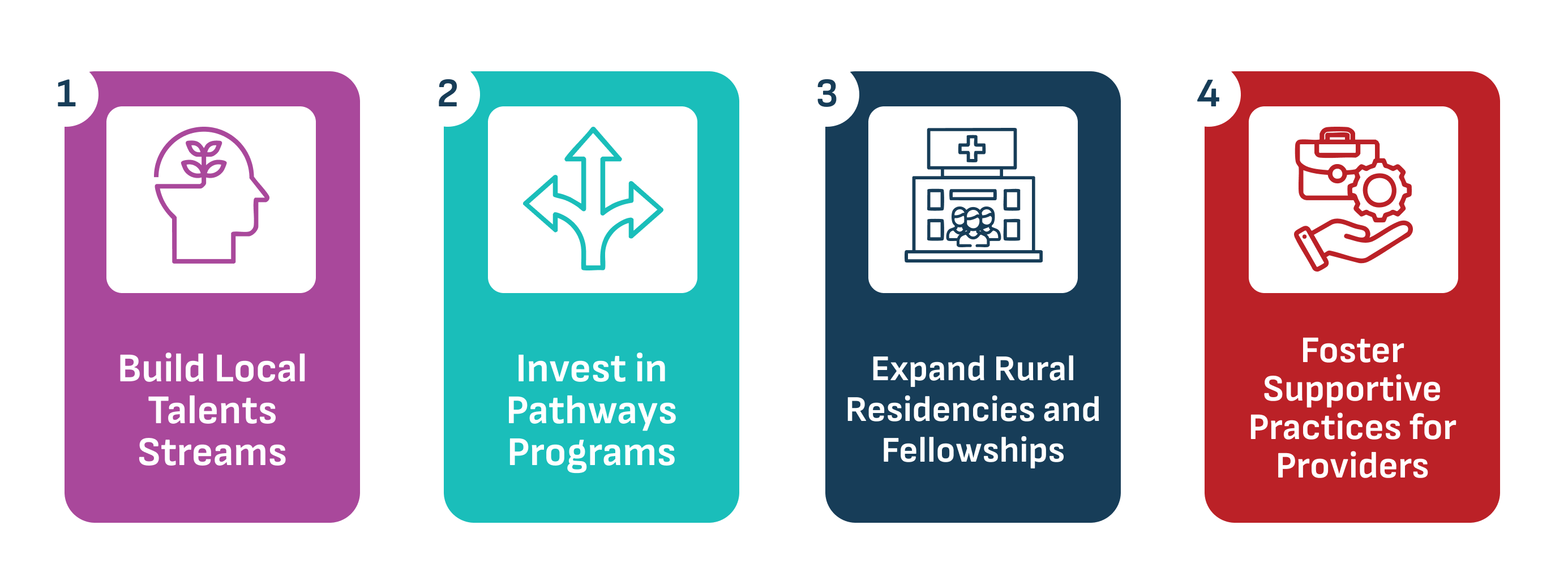

Build Local Talent Streams. “Grow Your Own” (GYO) programs recruit and train healthcare professionals from the local community, creating an entry point for healthcare careers, often without requiring a degree. Many GYO programs focus on allied health roles that expand the healthcare team, such as medical assistants (MAs), dental assistants, certified nursing assistants (CNAs), and community health workers (CHWs). GYO programs build a workforce that reflects the community, which strengthens trust with patients. Also, staff employed in their own communities are more likely to stay in their jobs due to shorter commutes, established personal lives, and personal commitment to the community.vii

Invest in Existing Staff. Pathways Programs offer opportunities for current staff to build their careers within the health center context. This can include on-the-job training to strengthen skills and competencies as well as opportunities for career advancement through degrees, certificates, and licensures. Staff engaged in learning opportunities report more job satisfaction – leading to better retention.

Expand Rural Residencies and Fellowships. Clinical placements and rotations through partnerships with academic health centers can help recruit clinicians; physicians, nurse practitioners, and physician assistants are more likely to choose a health center career when they train in that setting. States can grow rural residencies by increasing loan repayment amounts and expanding eligibility to dental and behavioral health providers. States can also offer housing and childcare stipends for rural placements and support multi-health center applications to enable residencies or rotations to be held across multiple sites.

Foster Supportive Practices for Providers. Supportive practices may include participation in licensure compacts to grow the pool of eligible candidates and reduce lengthy or complex state licensure requirements for faster onboarding and practice. Telehealth is also supportive because it enables scheduling flexibility and access to peer support when specialties are not located nearby. Additionally, team-based care models can optimize efficiency, reduce administrative burden, and increase provider satisfaction through working collaboratively and sharing responsibilities (i.e., working at the top of their license).
Health centers work diligently to strengthen the health workforce, but they urgently need comprehensive, evidence-based solutions. Abt Global supports workforce development across the country by:
Building and sustaining a strong health workforce isn’t just about filling positions—it’s about creating pathways for growth, fostering collaboration, and investing in the future of rural health. The strategies outlined here demonstrate that innovation and partnership can turn workforce challenges into opportunities for resilience and impact.
Explore these approaches, share them with your teams, and reach out. Together, we can ensure that every community has access to the care it deserves.
Sources:
i. Commonwealth Fund. (2025, November 17). The state of rural primary care in the United States. https://www.commonwealthfund.org/publications/issue-briefs/2025/nov/state-rural-primary-care-united-states
ii. Rural Health Research Gateway. (2023, August). Rural Health Research RECAP: Rural Behavioral Health Workforce. https://www.ruralhealthresearch.org/assets/5373-24554/behavioral-health-workforce-recap.pdf
iii. HRSA Bureau of Health Workforce. (2024, November). State of the behavioral health workforce, 2024. https://bhw.hrsa.gov/sites/default/files/bureau-health-workforce/state-of-the-behavioral-health-workforce-report-2024.pdf
iv. National Association of Community Health Centers. (2023, February). Closing the primary care gap: How community health centers can address the nation’s primary care crisis. https://www.nachc.org/wp-content/uploads/2023/06/Closing-the-Primary-Care-Gap_Full-Report_2023_digital-final.pdf
v. HRSA Data Warehouse. (2024). 2024 health center data. https://data.hrsa.gov/topics/healthcenters/uds/overview/national/table?tableName=Full&year=2024
vi. National Rural Health Association Policy Brief. (2025, March). Rural workforce recruitment and retention factors. https://www.ruralhealth.us/nationalruralhealth/media/documents/advocacy/nrha-policy-brief-workforce-retention-factors-final-3-7-25.pdf
vii. Patterson, D.G., Shipman, S. A., Pollack, S. W., Andrilla, C. H. A., Schmitz, D., Evans, D. V., Peterson, L. E., Longenecker, R. (2024). Growing a rural family physician workforce: The contributions of rural background and rural place of residency training. Health Services Research, 59(1), e14168. https://doi.org/10.1111/1475-6773.14168

Abt Global is a Sapphire sponsor of the NAMD 2026 Fall Conference. Find our Medicaid policy and data team at Booth 122.

Abt conducted an environmental scan of CMS-approved Medicaid reentry demonstrations, comparing how states are designing their programs and navigating different correctional settings.

Stronghold Federal’s GSA MAS award gives agencies streamlined access to IT modernization, data, and systems integration services.

How explainable, human-guided AI can help Medicaid programs focus on meaningful fraud signals, reduce noise, and act earlier.

Abt is testing whether the SMART Recovery program can reduce risky drinking and support military readiness.

Abt supports CMS in implementing and monitoring the MAHA ELEVATE Model to build evidence on functional and lifestyle medicine approaches to manage and improve chronic disease for Original Medicare beneficiaries.

Readiness is a data problem. We have solutions. Book a demo of our defense health data tools and meet our military health team.