
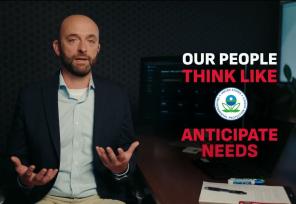
Client Focus: Forty Years of Trust at EPA
Video



BACKGROUND
Lead. PFAS. Perchlorate. Drinking water can have numerous chemical and microbial contaminants like these, putting millions of Americans at risk. The public sector needs evidence, tools, and technological innovations to identify how to mitigate risk in a cost-effective way.
Abt Global has managed, supported, and provided drinking water technical assistance to the Environmental Protection Agency (EPA) and other Federal agencies for more than 40 years, including its efforts to ensure that lead pipes are identified and removed everywhere from cities to tribal lands. We supported the Centers for Disease Control and Prevention’s Agency for Toxic Substances and Disease Registry (ATSDR) to measure and tackle contamination from per- and polyfluoroalkyl substances (PFAS). And we’re providing EPA with regulatory development support for:
Abt’s environmental team recently supported the EPA to finalize two landmark regulatory processes—to address lead, copper, and PFAS—that will improve drinking water safety for millions of people.
WHAT WE'RE DOING
As awareness grows about PFAS, communities want to know more about their exposure and risks. Abt developed a series of pharmacokinetic models to estimate blood PFAS levels due to the consumption of contaminated drinking water. These models incorporate background exposures and a person’s life stage, and account for uncertainty in the person’s potential exposure to PFAS.
Our teams used machine learning to calibrate, test and refine the models. We then built an online tool for users to estimate their personal PFAS exposure with no blood samples required. This gives people concerned about their own exposure more information to address their potential risk and helps fill a gap when blood testing is expensive or difficult to access. Since its launch, the PFAS Blood Level Estimation Tool website has been accessed by individuals in all 50 states and more than five countries.
Our multidisciplinary teams are critical to providing the innovative and comprehensive studies our clients need.
– Emma Glidden-Lyon, Environmental Policy and Regulatory Associate
We also collaborate with communities through information sessions and social media ad campaigns. Abt’s ad campaign in support of ATSDR’s PFAS exposure assessments produced nearly 2 million impressions (number of times the ads were seen) and nearly 2,500 link clicks in eight geotargeted communities.
Finally, we develop drinking water treatment technology evaluations that have been used by engineers and communities to evaluate the costs and effectiveness of different approaches to treat PFAS in community drinking water.
As the EPA updated regulations for emerging contaminants, Abt supported the Agency’s Office of Water to evaluate drinking water treatment technologies. Our analyses have covered national technologies and costs, best available technologies designation, and affordability of small system compliance for carcinogenic volatile organic compounds, fluoride, PFAS, and perchlorate. We’re currently developing these analyses for microbial contaminants and disinfection byproducts.
For each technology, we provided everything from detailed cost estimates and assessments of effectiveness for the target contaminant to pre- and post-treatment requirements, history of full-scale operation, and geographic applicability.
Any practical program for treating contaminants requires accurate cost estimates for the full treatment lifecycle and an understanding of what you get for the money: the treatment’s effectiveness. The EPA is required to consider costs and benefits, but that’s also how to build political support for the spending.
– Pat Ransom, Environmental Science Senior Associate
We have also reviewed scientific and engineering literature to add data to the EPA’s Drinking Water Treatability Database for other emerging contaminants, including 1,4-dioxane, anatoxin, arsenic, cis- and trans-1,2-dichloethylene, cyanide, cylindrospermopsin, fluoride, iodide, lithium, natural organic matter, microcystins, radium, strontium, trichloroethylene, and uranium.
We expanded the database’s coverage from two PFAS compounds in 2015 to more than 70 PFAS compounds today. The treatment technology cost models we developed for EPA can estimate costs for removing PFAS and more than 40 other contaminants, including many of those on EPA’s latest Contaminant Candidate List. These adaptable models can be extended to treatment for nearly any contaminant.
PFAS. Abt was instrumental in developing the economic analyses for the EPA’s PFAS rules in 2024 rules for PFAS. We led development of national compliance cost estimates and compared these estimates to projected public health benefits. We analyzed treatment effectiveness and affordability required to designate processes as best available technologies and small system compliance technologies. Our national spatial analysis helped EPA understand how the rule may affect communities facing socioeconomic and environmental challenges—and how to improve outcomes in these areas.
Lead and copper. For the EPA’s Lead and Copper Rule Revisions (LCRR) and the Lead and Copper Rule Improvements (LCRI), Abt modeled exposure to lead from drinking water to estimate the risk to human health. We also modified the SafeWater tool for lead and copper to estimate the benefits and costs of the rule under different options. We developed and implemented several approaches to evaluate how blood lead levels change with increasing exposures to lead in drinking water, while also considering non-drinking water sources of lead exposure.
Perchlorate. Abt supported the EPA’s development of an initial Maximum Contaminant Level Goal for perchlorate in 2019. When the EPA revisited the perchlorate standard in 2025, they turned to Abt again. We reviewed and developed modeling of the occurrence of perchlorate in drinking water using a Bayesian Hierarchical Model and simulated samples of drinking water with a Markov Chain Monte Carlo. We conducted research into the health effects associated with perchlorate and updated analyses by incorporating recent scientific findings on technology effectiveness and the latest unit costs from treatment technology vendors. And we developed the economic analysis for the EPA’s proposed perchlorate drinking water standard that synthesizes this research into national costs and benefits estimates. We are currently supporting the final National Primary Drinking Water Regulation for perchlorate.
Abt’s experience with every phase of drinking water regulation enables us to devise tailored solutions for different contexts. The SafeWater CBX computer model, for example, can assess different combinations of maximum contaminant levels (MCLs) and other model parameters. It can estimate benefit-cost ratios and economic impacts for different contaminants. The model can also simultaneously consider two or more user-specified MCLs for easy comparisons. Its flexibility is critical because factors like populations, exposure levels, environmental factors, and budget constraints vary from community to community.
IMPACT

Abt combined health, data science, regulatory, and technical expertise to support evidence-based regulatory processes. Our contributions included risk evaluation, economic and health impact assessment, rule drafting, public comment management, and final rule development. These new rules lay the groundwork for significant change, reducing risks of cancer, developmental disorders, and health risks for Americans nationwide. Here are two examples:
Through the 2024 PFAS rule, the EPA set limits for several PFAS in drinking water. Water systems must take action to reduce PFAS levels if the level exceeds regulatory standards. Regulated public water systems have three years to complete their initial monitoring for these chemicals, and systems must include their results in their Annual Water Quality reports to customers. Systems that detect PFAS above the new standards must then take actions to reduce PFAS and must also notify the public. This new rule protects 100 million people from PFAS in drinking water, saving lives and preventing illnesses.
The LCRR and LCRI protect millions of Americans from exposure to lead in drinking water. Key provisions include locating existing lead service lines, replacing nearly all lead lines within 10 years, strengthening tap sampling requirements, and lowering the threshold of lead in water for taking action. The rule also includes vital public notification requirements helping communities better understand risks. The EPA estimated that once the LCRI is implemented, each year it will help prevent:
WHY IT MATTERS
Abt continues to support EPA and other federal agencies to close critical regulatory gaps on some of the most harmful substances circulating in our water. Our approach to supporting complex regulatory processes demonstrates how strong data and digital tools translate into measurable public health and environmental benefits. This progress sends a clear signal that environmental health matters, and that data, regulation, innovation, and communities can align to protect people and the environment.
Note: An earlier version of this impact brief appeared in the 2025 Mission Impact Report. This 2026 version reflects updated information and recent progress.

Abt wins a seat on a USACE IDIQ supporting the data and analytics behind lock monitoring, dredging, and U.S. waterway statistics.

We combine topical expertise, environmental science, data analytics, & engineering to help agencies modernize systems & use data to support better decisions.

Abt supported the EPA in developing and implementing data-driven regulations for hazardous chemicals—particularly carbon tetrachloride—helping turn scientific evidence into enforceable protections that reduce risks to workers, nearby communities, and the environment.

Abt brings PFAS data tools and decision support for agencies facing urgent questions on exposure, health, and environmental response.

Abt's Adam Schaefer joins Dr. Ginger Dixon on One Health Wednesdays to explore the science, systems, and leadership driving meaningful progress in One Health research.

Meet Abt at SBCA 2026 to discuss how rigorous economic evidence can guide environmental and public policy decisions.

Abt used AI to standardize EPA off site chemical transfer data to 97% accuracy, enabling faster analysis and stronger chemical safety decisions.

Abt helps translate complex toxicology and exposure science into usable insights that support policy, programs, and public health action.

Abt’s partnership with USACE’s Waterborne Commerce Statistics Center strengthens America’s capacity to deliver reliable navigation data through AI-enabled waterborne commerce intelligence.

Abt Forward: Military Families, AI Leapfrogs, Mission Impact. Explore military family resilience, AI innovations, and community impact.

Presents findings from a multi-site study examining the relationship between PFAS-contaminated drinking water and PFAS levels in residents’ blood across the U.S.