

America's farmers and ranchers feed the world — but are the technology systems that serve them keeping pace?
The U.S. Department of Agriculture (USDA) Natural Resources Conservation Service (NRCS) helps sustain American agriculture by providing farmers and ranchers with financial and technical support to implement conservation practices. These efforts enable producers such as farmers and ranchers to take on work they could not do alone: installing fencing, restoring grasslands, and managing waterways that protect soil health and water quality nationwide.
Every conservation plan put to work on private land depends on the reliability, accuracy, and accessibility of the technology systems behind it. When those systems fall short, the consequences aren’t abstract: a farmer waiting on a delayed payment, a conservationist driving to a producer's property with paper forms instead of completing the work digitally, a rancher's application sitting in a manual backlog when planting season will not wait.
To address this, USDA’s Farm Production and Conservation (FPAC) Conservation Delivery Services BPA brought together three mechanisms known as Agile Release Trains (ARTs): Olympia, Odin, and Money. These cross-functional teams deliver coordinated system updates across a complex portfolio, from geospatial and soil data to financial systems that distribute over $6.8B in conservation funding each year.
Supporting more than 100 systems, this portfolio underpins how NRCS evaluates land, prioritizes investments, and delivers assistance. The challenge is clear: ensure these systems are reliable, timely, and accessible so producers and field staff can act when it matters most.
Building the systems that put conservation to work—on the ground, on time, and at scale.
Across the Olympia, Odin, and Money ARTs, Abt Digital Solutions led 250+ staff members through multiple programs and workstreams in the NRCS portfolio, managing over 100 science, financial, and data systems. The goal was consistent: Make it easier for NRCS employees to help producers with greater speed, transparency, and flexibility.
On Olympia/Odin, here’s how Abt strengthened the science and data infrastructure for conservation decisions:
- Modernized soils, geospatial, water, and climate systems used to assess land and plan practices
- Enabled precise mapping with LiDAR (high-resolution terrain scanning) and satellite imagery across large properties
- Applied predictive analytics to improve decisions on runoff, soil quality, and plant performance
- Enhanced Soils Data Mart, the authoritative national soils database, to support consistent, science-based planning nationwide
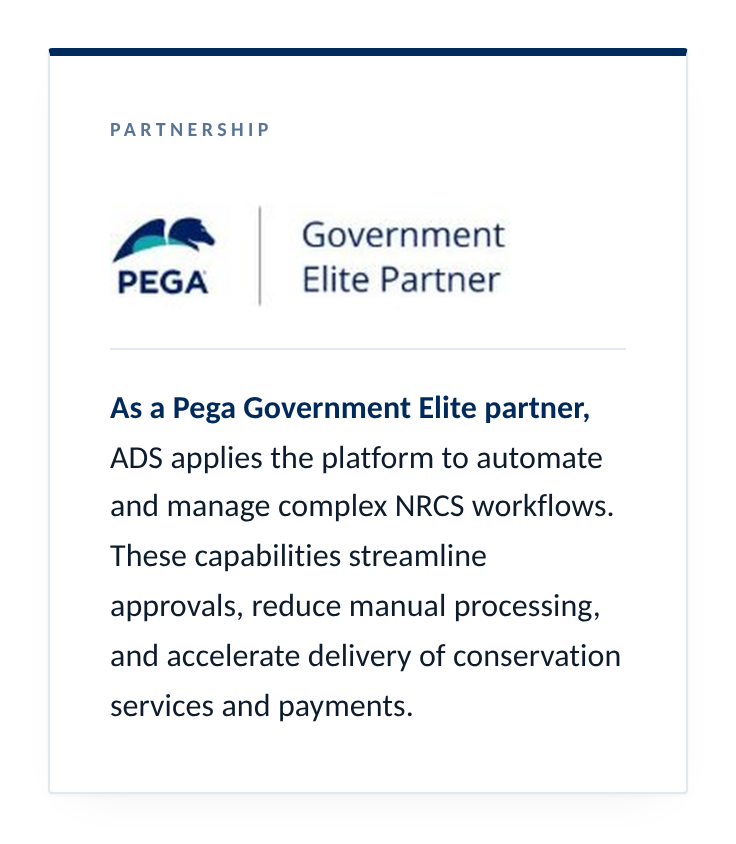
- Leveraged Pega platform to automate complex conservation workflows, reducing the manual burden on field staff and accelerating the delivery of services to producers
On the Money ART, here’s how Abt improved how conservation programs reach producers:
- Streamlined agreements, contracts, payments, and easements through modernized tools
- Reduced manual steps and simplified daily workflows for NRCS staff and producers
- Introduced the “Act Now” workflow to move high-ranking applications forward without batching delays
- Enabled faster decisions during critical planting windows
These results reflect more than technical delivery – we built systems grounded in a clear understanding of NRCS operations and user needs.
Enduring outcomes for America's producers.
Across three ARTs and five years of continuous performance, Abt delivered on three things that matter most to producers: faster access to the funds they are owed, time savings, and better tools for managing their land.
Access to funds improved through modernized tools.
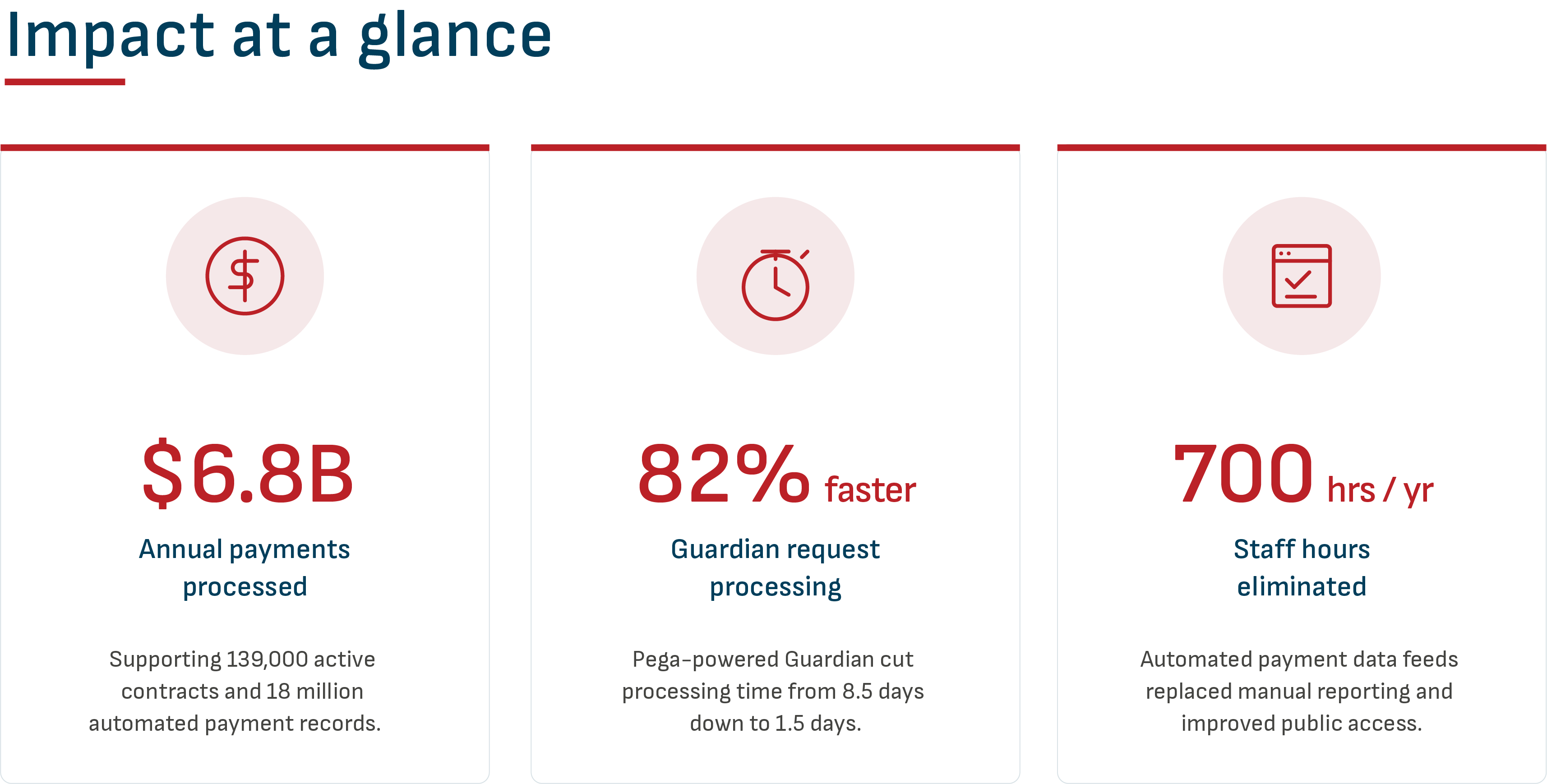
Money systems processed over $6.8 billion in annual payments, supported 139,000 active contracts, and automated 18 million payment records, removing bottlenecks that once delayed payments.
Digital workflows replaced manual steps that slowed delivery.
Where staff once relied on paper forms and in-person signatures, documents now move automatically through ProTracts, the Document Management System, and Farmers.gov. Producers can review and sign applications instantly, including from a mobile device. Tools like the National Easement Acquisition Tool (NEAT) centralized program management, accelerating application processing and payment delivery.
Time returned to producers and staff:
- Pega-powered Guardian system cut request processing time from 8.5 days to 1.5 days (82% faster)
- Fiscal year rollover automation reduced system downtime by more than 60%
- Automated payment data feeds eliminated 700 staff hours annually and improved public access to information
- The Letter Generator enabled fast, standardized communication in multiple languages
Delays in complex programs are being addressed.
Programs like Regional Conservation Partnership Program (RCPP) have relied on manual workflows for contract changes and payments, creating long wait times. Through the Conservation Desktop Applications and Agreements (CDAA) system, Abt is introducing automated obligations that replace these steps, giving producers and NRCS staff a faster, more reliable path from contract approval to payment, and greater flexibility to adjust plans as conditions change.
Better data improved decision-making.
We enhanced the Soils Data Mart, the national database used to evaluate land and determine eligibility for financial assistance. Conservationists now use digitized land units and geospatial services to assess conditions and rank projects, replacing manual mapping methods. This connects soil science directly to funding decisions, enabling more consistent and timely support for producers.
Conservation technology is the front line of American agriculture.

When conservation programs work seamlessly, farmers and ranchers can focus on what they do best: managing their land, growing their operations, and stewarding the natural resources that sustain American agriculture for generations. This is central to USDA’s mission to support working lands, strengthen rural communities, and conserve soil, water, and wildlife resources.
Abt’s work is a testament to why technology and mission delivery are inseparable. Faster payments allow producers to plan for the next season. Streamlined easement processing helps preserve working land. Better data equips conservationists to design more effective practices. These systems are how Farm Bill investments translate into measurable outcomes on private land.
We grounded our work in a clear understanding of NRCS operations and the realities of field use. This approach ensured solutions worked in the field, where timing, accuracy, and ease of use directly affect outcomes. By aligning system design with how conservation programs operate, Abt delivered tools that staff trust and producers can use when it matters most.
Featured in our 2026 Mission Impact Report
Related Content

Improving Conservation Services Through Agile Digital Transformation
TSPi is using agile teams to modernize the financial management portion of the Natural Resources Conservation Service’s information technology portfolio.

Feeding the Nation: How Innovation Fuels American Agriculture
America’s farmers feed our families and care for the land, whether they manage a few acres or thousands. Across the country, amid shrinking margins, producers face challenges in accessing loans, responding to disasters, and navigating federal assistance. USDA’s partnership with Abt Digital Solutions is making it easier for them to stay productive and steward America’s land.

Modernization & Automation

AI-Enabled Platform for Soil Data Analysis
Abt Digital Solutions built the Dynamic Soils Hub to modernize how USDA analyzes and applies soil data for conservation impact.