


Serious Solutions. Built on Abt Intelligence.
At Abt, AI has always stood for something — Abt Intelligence: our people, our expertise, our mission-driven approach to the world's hardest problems. Artificial intelligence is changing how government works, but the most successful projects begin with mission needs and human judgment. Abt helps public sector organizations use AI responsibly because we combine deep subject matter expertise with technical capability.
We offer a suite of AI solutions built on 60 years of mission-driven expertise, designed to extend your team's capacity without expanding your budget, and governed with the security, compliance, and human oversight federal environments demand.
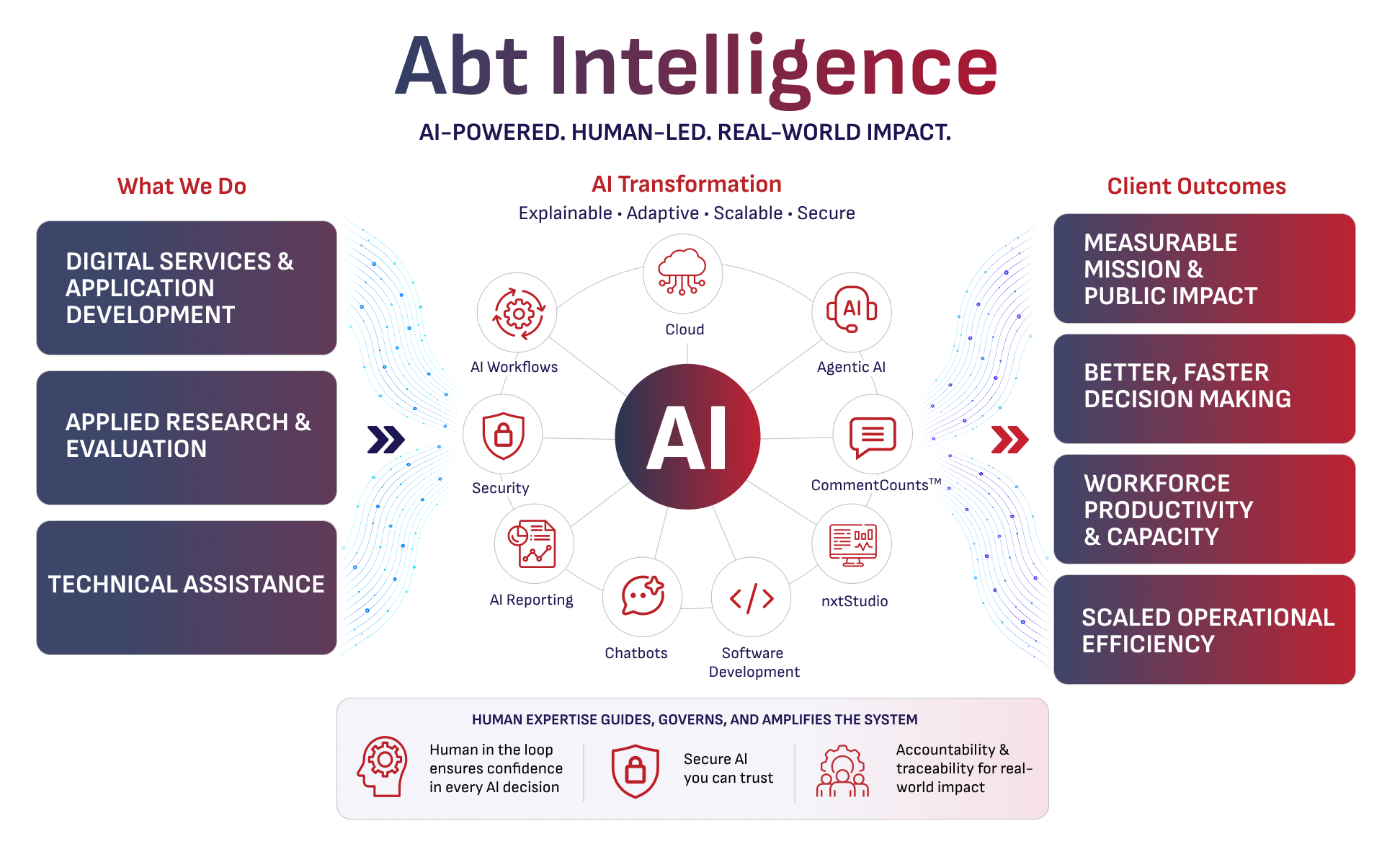
How Does Abt Use AI to Deliver Impact?
From piloting new ideas to deploying at scale, Abt is helping government clients harness AI. Here’s how:
AI Readiness and Advisory. We help agencies identify where agents can create the most meaningful impact, navigate the complexity of deployment, and build an actionable roadmap to set you up for success.
Fraud, waste, and abuse detection. Our tools embed fraud detection methods directly into agency workflows using flexible low-code frameworks, giving investigators real-time insights.
Literature review. We support evidence-based policymaking by pairing AI with subject matter expertise to accelerate literature scans, extract relevant claims, and organize findings for review.
Quality control. Abt’s demonstration for the Army Corps of Engineers showed how it could use AI and machine learning for cost estimates to incorporate more data, yielding more accurate forecasts.
Policymaking simulations. For the Centers for Medicare & Medicaid Services, we developed a simulation of nursing home staffing levels to understand impacts to patient care as well as costs to the nursing home industry of a proposed rule on Minimum Nursing Home Staffing Levels.
Data Ecosystem. For the Bureau of Justice Statistics, we piloted a generative AI approach to standardize how states classify criminal charges. By recreating an expert-built crosswalk in just 20% of the time and flagging potential inconsistencies, we enabled faster, more reliable national crime comparisons to support data-driven policy decisions.
Use Cases


Streamlining Medicaid Data
Client: Centers for Medicare and Medicaid Services
Medicaid managed care data often arrives from states in formats that are difficult to analyze such as PDFs and spreadsheets, meaning analysts were spending valuable time cleaning and validating submissions. Abt brought together policy and data engineering expertise to automate quality checks and validation steps using AI tools on a Databricks platform. This created a smoother data pipeline that ingests, integrates, and verifies state submissions. CMS now uses interactive dashboards that update in real time with quality-controlled information. Analysts can identify emerging patterns and potential risks, while remaining in full control of decisions.

Modernizing America’s Waterborne Commerce Intelligence
Client: U.S. Army Corps of Engineers (USACE)
Abt partnered with USACE to modernize the Waterborne Commerce Statistics Center’s TOWS platform, transforming it into a scalable, cloud-based system capable of processing data on more than 500,000 vessel trips and billions of tons of cargo each year. We streamlined multiple legacy tools, improved data accuracy, and significantly reduced processing time through automation. By enabling faster, more reliable analysis at scale, Abt is helping federal partners make data-driven decisions that keep America’s waterways and the economy they support running efficiently. Learn more.

Workforce Readiness
Client: Substance Abuse and Mental Health Services Administration (SAMHSA)
The best AI solutions fail without a workforce prepared to implement them. Abt worked with SAMHSA to ensure community-based organizations (CBOs), often reliant on outdated technology, could adopt AI responsibly and effectively. We developed and delivered a multi-day training for 30 CBOs, covering prompt engineering, AI ethics, and practical uses in behavioral health settings. We also established a peer learning network to foster continuous collaboration. By equipping frontline case workers and outreach specialists with real-world AI skills, Abt is helping government partners ensure that innovation enhances, not disrupts, service delivery. Learn more.


Tracking Chemical Transfers
Client: Environmental Protection Agency (EPA)
Abt partnered with EPA to improve the quality and usability of offsite chemical transfer data within the Toxics Release Inventory. By pairing deep subject matter expertise with advanced AI engineering, the team increased accurate standardization of records from about 70 percent to 97 percent and reduced a year of manual review to just weeks. The improved dataset now gives EPA a clearer view of where chemicals are going, strengthening risk analysis, transparency, and long-term AI readiness across the agency. Learn more.


Support to the Per- and Polyfluoroalkyl Substances (PFAS) Work
Client: Centers for Disease Control and Prevention (CDC)
PFAS are man-made contaminants in drinking water that lead to various health impacts, from low birthweight to impaired immune systems to increased cancer risk. Understanding how much PFAS is in someone’s blood is important for that person and for governments and agencies to set clear guidance on risk levels in communities. But PFAS blood monitoring is not readily accessible. Abt used AI predictive analytics to develop a model for researchers and the general public to predict blood levels based on drinking water exposure, incorporating hundreds of datapoints from multiple studies to refine estimates.

Linking Public Health Data
Client: Centers for Disease Control and Prevention (CDC)
CDC needed faster ways to spot disease patterns after the triple demic of flu, RSV, and Covid in the fall of 2022. Abt helped by integrating large billing datasets that covered about fifty million Americans to identify comorbidities that increase risk. We then linked that information across all states to census data so analysts could see which populations might be most vulnerable based on age, income, and where they live including nursing homes and other congregate settings. Because the data was incomplete, Abt used a statistical approach called multilevel regression and poststratification to account for missing values and produce realistic population estimates. CDC gained real time visibility into symptoms and emerging outbreaks, which supported resource planning and outreach to communities that needed public health support most. Learn more.
Connect with our experts or learn more about our Digital & Data Services
Our Experts:


Contact Us
Additional Resources

A Use Case Roadmap for AI-Ready Community Health
A three-step process and scoring matrix help healthcare teams find, refine, and prioritize AI ideas that deliver real, measurable impact.

AI Helps EPA Standardize and Sharpen Toxic Chemical Data
Abt used AI to standardize EPA off site chemical transfer data to 97% accuracy, enabling faster analysis and stronger chemical safety decisions.

Abt Global Announces Partnership with Rhino.AI to Accelerate AI Modernization Across Federal Agencies
Abt Global announced a strategic partnership with Rhino.ai, a U.S. artificial intelligence company fast gaining acclaim for its automated modernization capabilities.

AI-Enabled Platform for Soil Data Analysis
Abt Digital Solutions built the Dynamic Soils Hub to modernize how USDA analyzes and applies soil data for conservation impact.

AI Enabled Code Conversion for Legacy System Modernization
Abt uses AI-enabled code conversion to help federal agencies modernize legacy systems securely, efficiently, and at scale.

Agentic AI for Citizen-Centered Services
Agentic AI helps federal agencies deliver faster, simpler, and more secure citizen services—driving real mission outcomes at scale.