


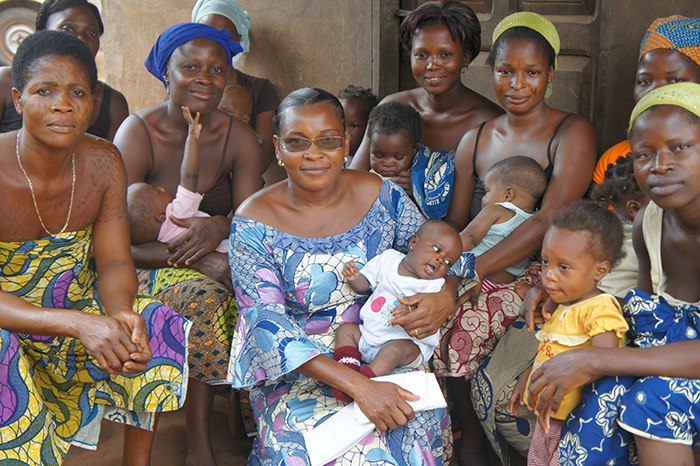
Mothers and children often lack basic health services in Benin. That leads to worsening health and preventable deaths among infants, schoolgirls, and women, particularly the extremely poor. An Abt-led US Government health assessment in 2013 found an underperforming private sector contributed significantly to the lack of high-quality reproductive, maternal, neonatal, and child health (RMNCH) services and products.
Benin’s Private Health Sector Platform (Plateforme du Secteur Privé de la Santé or PSSP) is helping to change this. Launched in 2014 based on a recommendation from Abt’s health assessment, PSSP plays an increasingly visible role as the sector’s primary advocacy group and chief interlocutor for the private sector with Benin’s Ministry of Health. PSSP is also a major partner to the Abt-led Private Sector Health Partnership Activity (PSHPA)—which shares its goal to unite and strengthen the country’s private health sector.
Many Beninese, including 14 percent of women giving birth and 35 percent of those afflicted with malaria, seek health services from commercial and nonprofit providers. But the private sector has lacked the power and capacity to meet rising demand due to an unfavorable regulatory environment, uneven service quality, and spotty public awareness of products and services.
That’s where PSSP comes in. When it started, two USG projects, including Abt’s Health Finance and Governance project, provided technical training and operational guidance. Since 2018, PSSP has partnered with PSHPA to raise the quality and availability of private RMNCH services and products, a huge step to reducing maternal and child deaths and improving health outcomes in Benin.
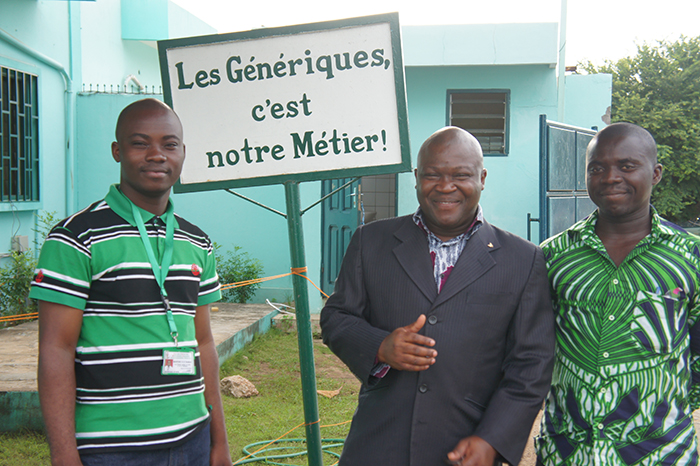
Embedded assistants mobilize action
PSHPA recruited technical assistants to work within PSSP on its institutional and organizational development and health business development. With this guidance, PSSP established an information intelligence team that captures, analyzes, and guides resource-generating opportunities, from a new e-learning platform for its members to off-grid solar power. PSHPA has also mentored PSSP on how to conduct financial audits, which show a funding pipeline of approximately $200,000 so far. Demonstrated funding is essential for attracting new business.
"They took the issue of self-determination of the PSSP seriously and stuck their necks out with us,” said PSSP’s executive secretary, Pascal Fafeh. “Without their input, we would not have the time to mobilize so many actors and technical capacities to jump on new opportunities.”
PSSP now represents 20 private sector health associations, up from zero in 2018, when its PSHPA partnership began. PSSP supports registration and accreditation for its members and advocates for changes in laws and regulations affecting the private sector. In addition to Abt, it holds contracts with other implementing partners and other donors including UNICEF and the Belgian development agency. PSSP’s impact on health outcomes and its analytical and auditing capabilities, among other things, are preparing PSSP to receive direct USG funding—a major goal of localization.
PSSP also hosts annual Private Health Sector Days, bringing together hundreds of government officials and health professionals to spotlight this historically overlooked segment of the country’s health system. This event showcases private sector health achievements, explore challenges, and build relationships within the sector and with government attendees—all while reinforcing PSSP’s leadership. PSHPA looks forward to collaborating on one final Private Health Sector Day in May 2023 prior to the project’s close.
“The sharing of each member association’s main achievements, the informative and formative communications on the ongoing health reforms and on the associative governance contributed to the success of these days and reflect the strength of a ‘rainbow PSSP,’” said PSSP President Dr. Lucien Dossou-Gbete. “This undoubtedly induces a positive change of opinions on the PSSP and the private sector in the Beninese health system.”
Read More
Private Sector Health in Sub-Saharan Africa

Bolstering Global Health Security in a Changing Environment
Environmental hazards require adaptive global health security strategies.

Beyond COVID-19: What Global Health Security Will Look Like
As leaders focus on pandemics and global health security, they should look at three related items: other diseases, social determinants of health, and logistics.

Engaging Private Health Providers to Extend the Global Availability of PMTCT Services
The past decade has seen tremendous progress in making services to prevent mother-to-child transmission of HIV (PMTCT) more available in many HIV high-prevalence settings. Despite this progress, new HIV infections among pregnant women, newborns, and infants remain unacceptably high, and AIDS remains one of the leading causes of death among women of reproductive age and infants worldwide.To eliminate mother-to-child transmission, HIV programs are increasingly seeking ways to engage private actors more fully in expanding and sustaining national HIV and PMTCT responses. This technical brief presents options for engaging private sector actors in rapidly extending the availability of PMTCT services. The discussion includes successes, lessons, and challenges that can inform the efforts of governments, donors, and implementers to adapt or replicate private sector models in new settings.Abt staff members contributed to the report, including Senior Associate James J. White, Senior Analyst Sean Callahan, Associate Analyst Samantha Lint, and former Abt Analyst Helen Li.
Providing Free Pregnancy Test Kits to Community Health Workers Increases Distribution of Contraceptives: Results from an Impact Evaluation in Madagascar
To improve access to contraceptives in remote and rural areas, sub-Saharan African countries are allowing community health workers (CHWs) to distribute hormonal contraceptives. Before offering hormonal contraceptives, CHWs must determine pregnancy status but often lack a reliable way to do so. We assessed the impact of giving CHWs free pregnancy test kits on the number of new clients purchasing hormonal contraceptives from CHWs.We implemented a randomized experiment in Eastern Madagascar among CHWs who sell injectable and oral hormonal contraceptives: 622 CHWs were stratified by region and randomly assigned at the individual level. Treatment-group CHWs were given free pregnancy tests to distribute (n analyzed=272) and control-group CHWs did not receive the tests (n analyzed=263). We estimated an ordinary least squares regression model, with the monthly number of new hormonal contraceptive clients per CHW as our primary outcome.We find that providing CHWs with free pregnancy test kits increases the number of new hormonal contraceptive clients. Treatment-group CHWs provide hormonal contraceptives to 3.1 new clients per month, compared to 2.5 in the control group. This difference of 0.7 clients per month (95 percent CI 0.13–1.18; p=0.014), represents a 26 percent increase.