


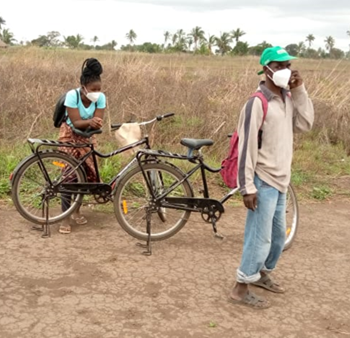
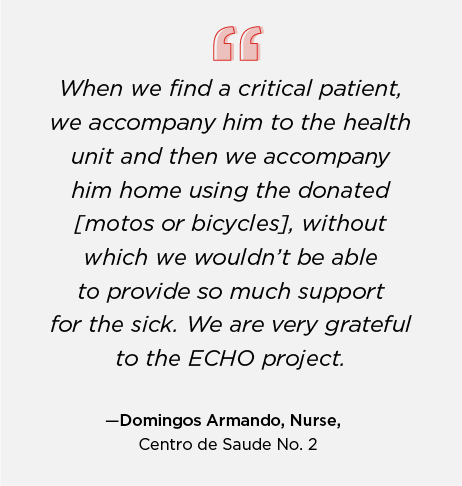
As part of an initiative to build local capacity, Abt is empowering community organizations in Mozambique to “own” health service delivery and quality improvement interventions. This capacity building can be provided through a variety of vehicles—literally and figuratively—from technical assistance to motorcycle procurement. For example, people living in remote areas of Mozambique often struggle to access faraway health facilities. While local organizations try to connect these patients with services, they often lack the resources and capacity they need to literally cover the ground in service delivery. To provide long-term solutions to increasing capacity, the Abt-led Efficiencies for Clinical HIV Outcomes (ECHO) project procured 37 motorcycles and 1,337 bicycles to shorten the time it takes for community health workers to travel to support patients. The bicycles serve as a foundation for community preventive visits, integration and reintegration into HIV treatment, and HIV testing, and they enable health workers to use shorter routes that are inaccessible by car. Motorcycles help the community-based organizations’ (CBO) technical supervisors provide on-site monitoring of the community workers’ activities and reach patients that were not accessible even by bikes.
Thanks to this initiative, there are significantly fewer patients with interrupted HIV treatment. Between September and December 2021, bikes helped community health workers reach 98 percent of HIV patients in their communities who had abandoned or interrupted their treatment. According to counselors in Sofala province—where interruptions to service dropped by almost 63 percent—these bike donations are enabling health workers to integrate new patients and ensure they maintain treatment.
Moving forward, ECHO is expanding its initiative to assess—and address—additional CBO needs, aiming to identify unique long-term challenges for which Abt can provide sustainable solutions. For example, many CBOs have expressed a need for harassment, ethics, and gender trainings that will build a solid cultural foundation for the organizations and strengthen their mission. Abt and our partners conducted assessments to learn exactly where each CBO’s strengths and weaknesses lie in areas of gender, management practices, ethics, communication, and more. In addition to delivering harassment and ethics trainings, we trained the trainers. Results have been gratifying; in one province, assessment scores before and after harassment and ethics trainings skyrocketed from 45 percent to 80 percent.
By using data to identify and provide both material and technical assistance, Abt continues to give Mozambique’s CBOs the tools and knowledge they need to improve HIV patients’ lives for years to come.
Read More
Infectious Diseases & Global Health Security in Sub-Saharan Africa

Bolstering Global Health Security in a Changing Environment
Environmental hazards require adaptive global health security strategies.

Beyond COVID-19: What Global Health Security Will Look Like
As leaders focus on pandemics and global health security, they should look at three related items: other diseases, social determinants of health, and logistics.

Improving Immunization Programming in Mozambique
An analysis of Mozambique’s 2015 immunization spending reveals that despite adequate resources and increases in immunization coverage, challenges to the immunization program persist. In addition to examining the efficiency of the immunization program, Mozambique would benefit from efforts to report and compile immunization spending data more effectively.This policy brief and the underlying health accounts exercise have been supported by Abt Global, through a grant secured from the Bill and Melinda Gates Foundation.Also available in Portuguese.

A Concise, Health Service Coverage Index for Monitoring Progress Towards Universal Health Coverage
There is a growing international commitment to universal health coverage (UHC), but limited means to determine progress towards that goal. The authors developed a practical index for capturing health service coverage – a critical dimension of UHC -- that was more inclusive than previous methods.The approach moved beyond common indicators of service coverage focused on infectious diseases and maternal and child health, to include information on necessary health inputs. The resulting, balanced, composite index of health service coverage demonstrated promise as a metric, likely to discriminate coverage levels between countries and regions. An important number of service provision indicators were correlated, therefore a reduced set of services performed well as a proxy for the full set of available indicators. This parsimonious index is a start toward simplifying the task of policy-makers monitoring progress on a key domain of universal health coverage.