

Video Podcast: Eric Reading and Allison Cantrell EP1
Video


PMI Evolve
Malaria remains one of the world’s deadliest mosquito-borne diseases, with the greatest burden concentrated in sub-Saharan Africa. Children under 5 and pregnant women face the highest risk of severe illness and death. At the same time, growing insecticide resistance threatens the effectiveness of traditional mosquito control tools, making it harder for national malaria programs to protect communities and sustain progress.
Countries also face operational challenges that affect malaria prevention efforts, including supply chain constraints, shifting transmission patterns, and the need for stronger local systems and data to guide decisions.
The U.S. President’s Malaria Initiative (PMI) Evolving Vector Control to Fight Malaria Project (otherwise known as PMI Evolve) supports PMI and the U.S. Department of State to help governments respond with targeted, evidence-based vector control strategies that protect vulnerable populations and strengthen country-led malaria programs.
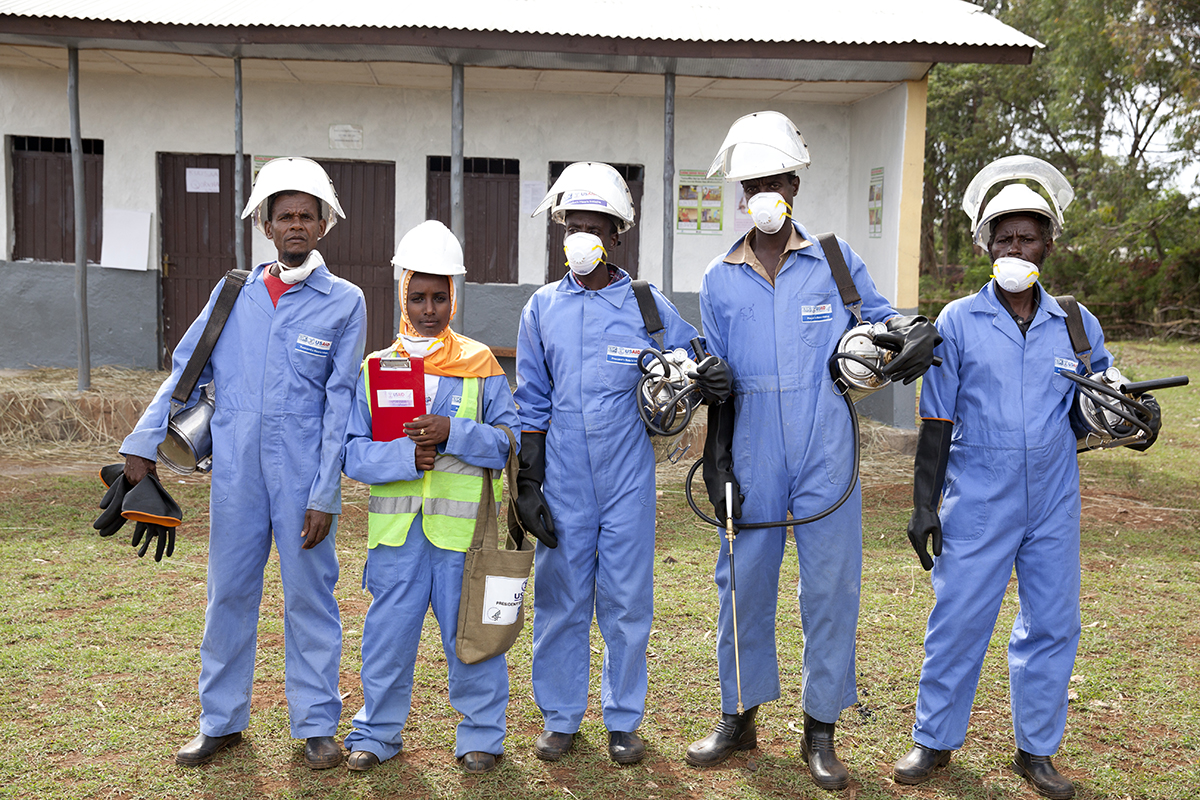
Managed by Abt Global, PMI Evolve supports integrated vector control programs that combine proven malaria prevention tools with data-driven decision-making. The project works closely with national malaria programs to plan, implement, and monitor indoor residual spraying (IRS) campaigns and insecticide-treated net (ITN) distributions through mass campaigns, schools, health facilities, and community channels.
The project also supports insecticide resistance monitoring and real-time data systems that help countries select the right tools for local conditions. In 2026, PMI Evolve began rolling out U.S.-made spatial emanators in several countries, adding a new technology designed to strengthen protection and reduce costs alongside IRS and ITNs.
In 2025, PMI Evolve protected more than 8.6 million people through IRS campaigns and supported the distribution of 4.9 million insecticide-treated nets, protecting another 9.8 million people. The project also supported government-led campaigns that distributed an additional 9.6 million nets, extending protection to an estimated 19.3 million people.
Across 19 countries in sub-Saharan Africa and Cambodia, PMI Evolve trained 42,700 people in vector control activities and conducted insecticide resistance monitoring at 83 sites to guide evidence-based malaria prevention strategies.
Learn more:

Locally led infrastructure and governance approaches have stabilized access to clean water, supported schools and rural markets, and built long-term community ownership.

Abt Global, through PMI Evolve, is piloting a new US-made malaria fighting technology in six African countries—now being scaled up through a new partnership with SC Johnson, the U.S. Department of State, and the Global Fund.

From partnerships to policies, Vietnam is demonstrating how countries can sustainably transition their HIV response from donor-funded to country-led.

Abt Global’s proven health systems solutions — spanning financing, efficiency, resilience, private sector engagement, and digital integration — equip partner governments to sustain health gains and transition donor-funded programs to full country ownership.

Abt Global’s proven health systems solutions — spanning financing, efficiency, resilience, private sector engagement, and digital integration — equip partner governments to sustain health gains and transition donor-funded programs to full country ownership.

Abt congratulates the United States Government and the Republic of Mozambique on signing a memorandum of understanding that marks an important step in implementing the America First Global Health Strategy.

The Abt-managed Fiji Program Support Platform implements a portfolio of Australian Government-funded development programs, in alignment with Fiji's national priorities and the Australia-Fiji Vuvale Partnership.

In Mozambique, the largest transition to locally led HIV program in the world is underway.